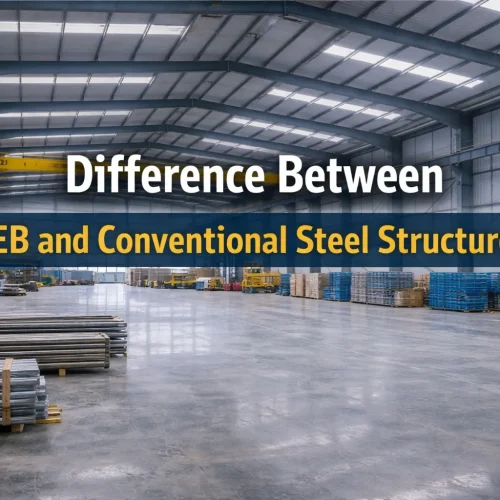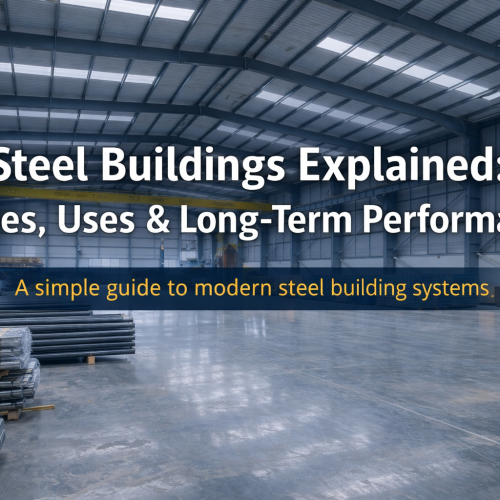
Steel and RCC (Reinforced Cement Concrete) are the two most commonly used construction systems today. While RCC has been used for decades, steel buildings are now preferred for many industrial, commercial, and large-span projects due to speed, flexibility, and long-term performance.
This blog explains the advantages of steel buildings over RCC structures in a simple and practical way, helping beginners, project owners, and planners understand why steel construction is gaining popularity.
Understanding Steel Buildings and RCC Structures
Before comparing advantages, it is important to understand the basic difference.
- Steel buildings use steel columns, beams, and frames as the main load-bearing system.
- RCC structures use concrete mixed with steel reinforcement bars, cast and cured at the construction site.
Both systems have their uses, but steel buildings offer clear advantages in many scenarios.
Faster Construction Time
One of the biggest advantages of steel buildings is speed of construction.
Steel components are fabricated in factories and delivered ready for installation. On-site work mainly involves assembly using bolts and fasteners.
RCC construction requires:
- Shuttering
- Steel bar fixing
- Concrete pouring
- Curing time
These steps make RCC projects time-consuming.
Steel buildings help reduce project timelines significantly, which is critical for industries and commercial operations.
Lightweight Structure with High Strength
Steel has a high strength-to-weight ratio.
This means:
- Steel buildings are lighter
- Structural loads on foundations are reduced
- Foundation cost can be optimised
RCC structures are heavy, increasing foundation size and cost.
Despite being lightweight, steel buildings can safely support heavy machinery and large roof spans.
Large Clear Spans Without Columns
Steel buildings can cover large areas without internal columns, making them ideal for:
- Factories
- Warehouses
- Workshops
- Industrial sheds
RCC structures have span limitations and often require multiple columns, which can obstruct internal movement and layout planning.
This is why steel is widely preferred for industrial and warehouse applications.
Design Flexibility and Customisation
Steel allows greater design flexibility compared to RCC.
Steel buildings can be:
- Modified easily
- Extended in the future
- Designed for varying heights and spans
RCC structures are rigid. Any future change requires major demolition and reconstruction.
Modern steel construction systems support flexible layouts and long-term scalability.
You can understand this better by exploring how
steel construction
is applied in large-scale projects.
Better Quality Control
Steel components are manufactured in controlled factory environments.
This ensures:
- Accurate dimensions
- Better welding and finishing
- Reduced material wastage
- Consistent quality
RCC construction depends heavily on on-site workmanship, weather conditions, and curing quality, which can affect consistency.
Lower Maintenance Over Time
Steel buildings require less maintenance when compared to RCC structures.
With proper coating and corrosion protection:
- Steel resists cracking
- Structural performance remains consistent
- Repairs are minimal
RCC buildings often develop:
- Cracks
- Water seepage
- Surface deterioration
Over time, maintenance costs can be higher for RCC structures.
Easy Future Expansion
One major advantage of steel buildings is ease of expansion.
Additional bays or extensions can be added by:
- Removing end walls
- Extending the frame system
This is especially useful for growing industries and storage facilities.
RCC buildings are difficult and expensive to expand due to structural limitations.
Better Performance for Industrial Use
Steel buildings perform better in industrial environments because they can:
- Support heavy loads
- Accommodate cranes and equipment
- Withstand vibration from machinery
This makes steel buildings suitable for demanding industrial operations.
Many modern
steel buildings
are designed specifically for such high-performance requirements.
Cost Efficiency in the Long Run
Although initial material cost may vary, steel buildings often prove more economical over the life cycle.
Reasons include:
- Faster completion (early operations)
- Reduced labour costs
- Lower maintenance
- Easy expansion
RCC projects may appear cheaper initially but often involve higher time and maintenance costs.
Environmental Benefits
Steel buildings are more environmentally friendly because:
- Steel is recyclable
- Construction waste is minimal
- Factory fabrication reduces site pollution
- Energy-efficient insulation systems can be integrated
RCC construction produces more waste and consumes more water and raw materials.
Application Comparison: Steel vs RCC
Steel buildings are ideal for:
- Industrial units
- Warehouses
- Logistics facilities
- Commercial sheds
Steel is especially suitable for
warehouse steel construction
where large clear spans and fast delivery are required.
RCC structures are generally suitable for:
- Residential buildings
- Small-scale commercial buildings
- Architecturally complex structures
Role of Fabrication in Steel Building Performance
Precision fabrication ensures proper alignment and strength of steel components.
Accurate
steel fabrication
reduces errors, improves erection speed, and enhances structural reliability.
RCC construction depends more on manual execution, increasing variability.
When Should You Choose Steel Over RCC?
Steel buildings are the better choice when:
- Fast construction is required
- Large spans are needed
- Future expansion is planned
- Industrial usage is involved
- Long-term cost efficiency is important
RCC is suitable mainly for low-rise residential and small buildings.
Conclusion
Steel buildings offer clear advantages over RCC structures in terms of speed, flexibility, strength, maintenance, and long-term value. For industrial, warehouse, and large commercial projects, steel construction provides practical and future-ready solutions.
Understanding these advantages helps project owners choose the right construction system based on usage and long-term goals.