
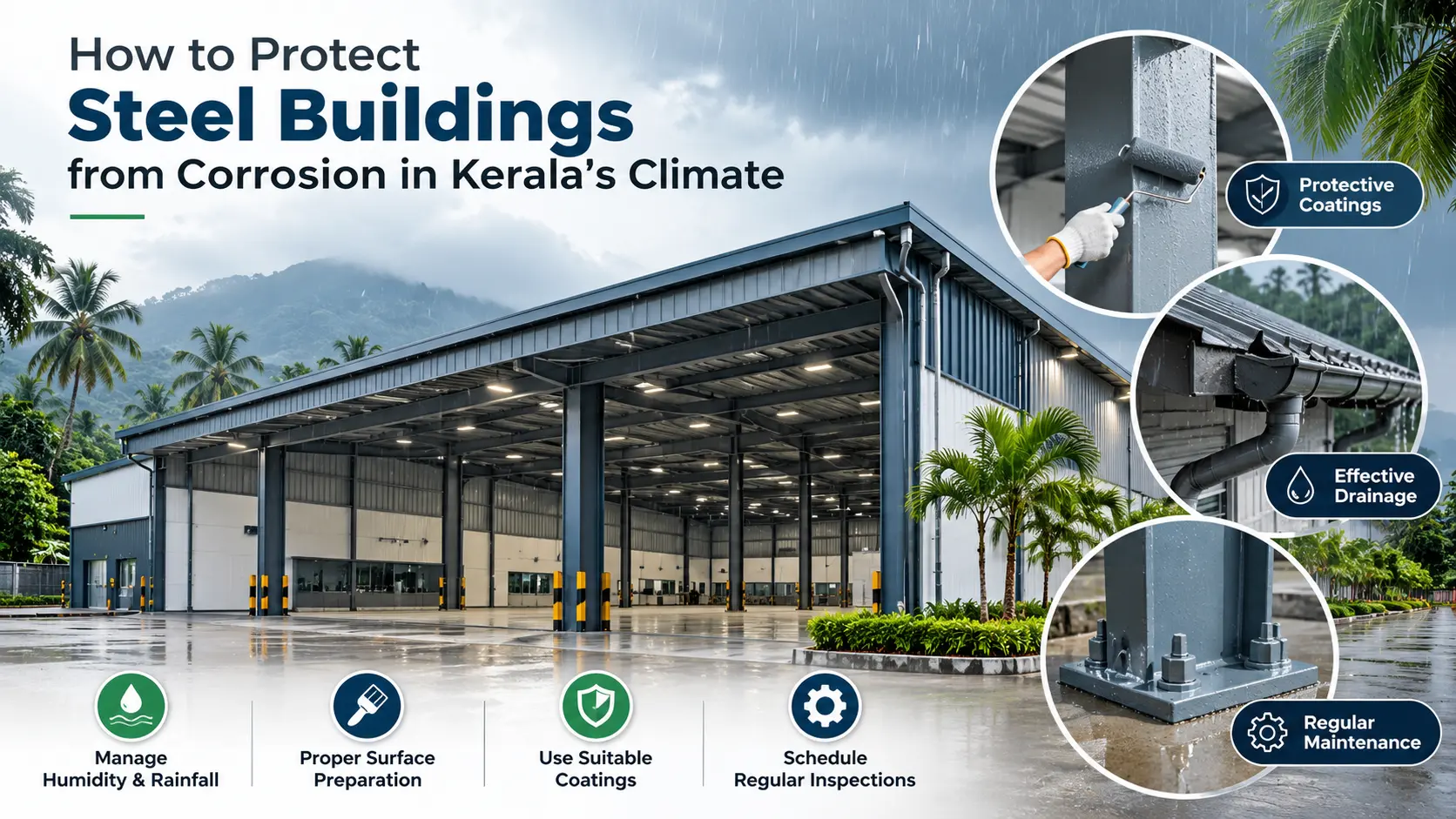
Steel is widely used in warehouses, industrial buildings, showrooms, commercial complexes, and other modern construction projects. However, in a climate like Kerala’s, protecting steel from corrosion is an important part of building design and long-term maintenance. Kerala experiences seasonal monsoon rainfall, high humidity, and prolonged wet conditions. These factors can increase the risk of corrosion when steel surfaces are exposed to moisture without suitable protection. The state’s climate profile also highlights its generally humid conditions and substantial annual rainfall. Steel structure corrosion protection involves more than applying paint to a metal surface. It includes choosing a suitable protective system, preparing the steel correctly, designing the structure to manage water, and inspecting the building throughout its service life. For property developers and business owners planning a steel building in Kerala, these measures should be considered from the initial design stage rather than only after rust appears. What is steel structure corrosion protection? Steel structure corrosion protection is the process of reducing or preventing the deterioration of steel caused by its surrounding environment. It may involve protective coatings, galvanizing, appropriate structural detailing, effective drainage, and regular maintenance. The right method depends on factors such as humidity, rainfall exposure, proximity to the sea, industrial pollution, the type of steel member, and the expected service life of the building. International Standard ISO 12944 provides guidance on protective paint systems for steel structures and considers environmental exposure, surface preparation, design, and maintenance. For buildings in Kerala, a protection system should be selected according to the actual conditions at the project site. A steel warehouse in an inland location may require a different approach from a commercial building near the coast. 1. Understand how Kerala’s climate affects steel structures Corrosion occurs when steel reacts with its environment. Moisture and oxygen are important factors in the rusting of ordinary carbon steel. Certain environmental conditions can make the process faster. High humidity and prolonged moisture High humidity can allow moisture to remain on steel surfaces for longer periods. When moisture collects on exposed steel, joints, or areas where the protective coating is damaged, the risk of corrosion increases. This is particularly relevant for structures with exposed steel columns, roof trusses, external connections, and partially enclosed areas. Heavy rainfall and water accumulation During the monsoon, rainwater may enter areas that are not properly protected or drained. Water trapped around connection plates, horizontal ledges, roof gutters, and base plates can contribute to coating deterioration and corrosion. Regularly checking these locations is important, especially before and after the monsoon season. Coastal air and salt exposure Steel buildings near the Kerala coastline may be exposed to airborne salts. Salt deposits can increase the corrosiveness of moisture on steel surfaces and may shorten the useful life of an unsuitable coating system. Buildings close to the sea should therefore be assessed carefully when selecting protective coatings, metallic protection, and maintenance intervals. Industrial and chemical exposure Some industrial environments contain airborne pollutants, chemical vapours, or other substances that can affect protective coatings. Warehouses and industrial facilities should be assessed according to their actual use and surroundings. The main point is simple: the corrosion protection system must match the building’s exposure conditions, not just its appearance or initial construction budget. 2. Choose the right protective coating system Protective coatings create a barrier between steel and its environment. When properly selected and applied, they help reduce direct contact with moisture and other corrosive substances. However, there is no single coating that is automatically best for every steel building. Common steel corrosion protection methods Protection method How it helps Important consideration Primer and paint system Creates a protective barrier and provides a suitable finish Requires correct preparation, application, and maintenance Epoxy coating system Can provide a durable protective layer in suitable environments Product selection and compatible topcoats matter Polyurethane topcoat Can provide weathering and colour retention benefits in suitable systems Must be compatible with the underlying coating Hot-dip galvanizing Applies a zinc coating that protects steel through barrier and sacrificial action Component dimensions, fabrication, and exposure conditions must be considered Combined coating and galvanizing systems Can provide additional protection in selected applications Requires compatible materials and a project-specific specification These methods are not interchangeable in every situation. For example, a paint system designed for ordinary atmospheric exposure may not be suitable for a highly corrosive coastal or industrial environment. ISO 12944 addresses protective paint systems and the environmental conditions in which they are used. Its guidance can help project teams specify suitable protection rather than selecting products only by price. How should you choose a coating for a steel building? Before selecting a coating, discuss the following points with the design or coating specialist: The specification should identify the coating products or system, surface preparation requirements, application conditions, and inspection criteria. Avoid relying only on a general instruction such as “apply anti-rust paint.” 3. Prepare the steel surface properly before painting One of the most important steps in steel structure corrosion protection is surface preparation. Even a high-quality coating may fail prematurely if it is applied over rust, loose mill scale, dust, oil, grease, salts, or other contaminants. Surface preparation helps the protective coating adhere properly and perform as intended. ISO 12944-4 specifically covers surface types and preparation for steel surfaces used with protective paint systems. What does proper surface preparation involve? The exact procedure depends on the steel condition and the selected coating system. Typical steps may include: Abrasive blasting may be appropriate for some projects, while mechanical cleaning may suit other situations. The correct method depends on the coating specification and the condition of the steel. Why should surface preparation not be ignored? Skipping this step to save time can lead to peeling paint, blistering, early rust formation, and expensive repair work. For large warehouses and industrial buildings, the surface preparation process should be planned alongside fabrication, transportation, and erection. The construction team must also protect prepared and coated members from damage during handling. 4. Design the building to prevent water accumulation Corrosion protection should